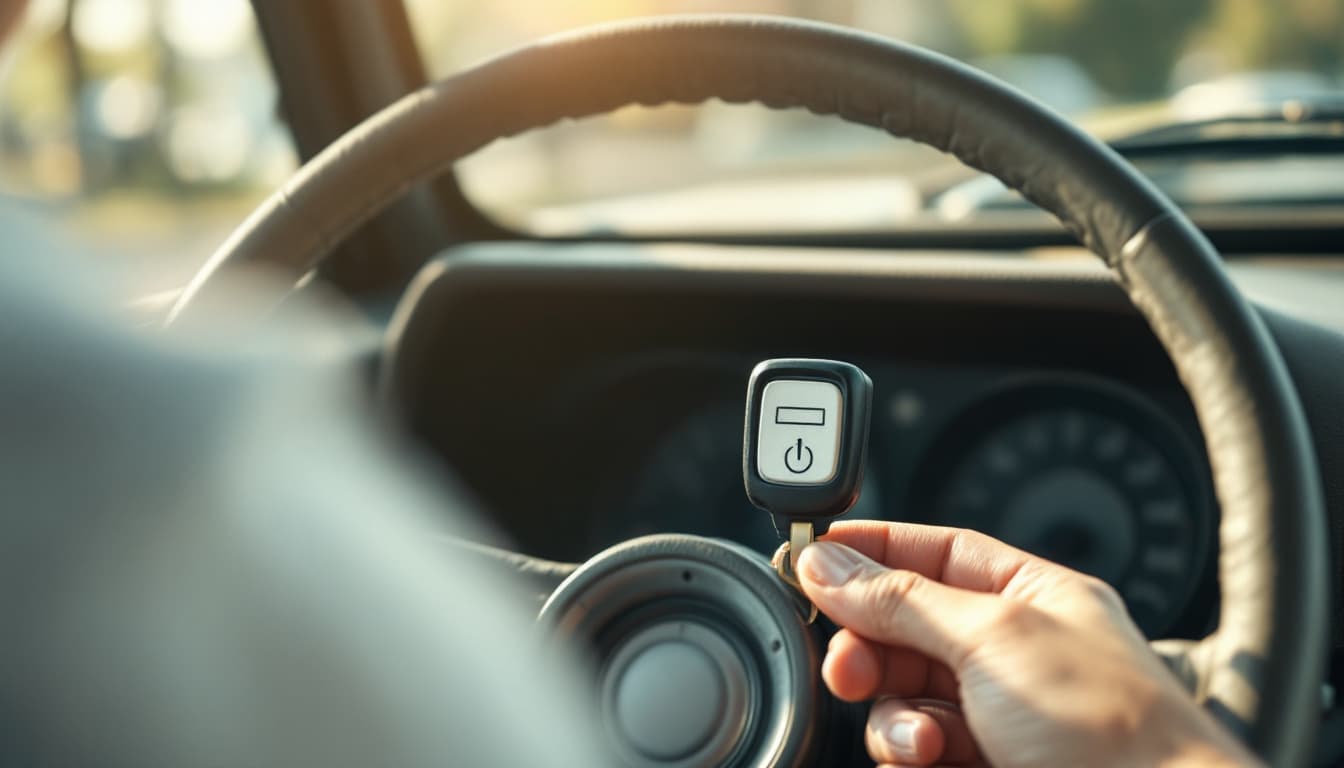
Key Turns But Nothing Happens — No Crank, No Click in Keller TX
You turn the key and get silence — no crank, no click, sometimes no dash lights. A Keller TX automotive locksmith walks through the six causes, how to tell them apart in your driveway, and what each one costs.
Key Turns But Nothing Happens — No Crank, No Click in Keller TX
The key turns all the way. It feels completely normal. And the car does absolutely nothing — no crank, no click, no whirring, sometimes not even a flicker on the dash. Call or text (817) 968-3866. This is a genuinely diagnosable symptom, and the difference between the cheap cause and the expensive one is usually visible from the driver's seat in about two minutes.
Quick Answer
A key that turns freely with total silence usually means the electrical signal is not reaching the starter. The six realistic causes are a dead battery or bad connection, a failed ignition switch behind the cylinder, a worn cylinder that turns without engaging, a park/neutral safety switch fault, a starter or relay failure, or an anti-theft lockout. The dash lights tell you which half you are in.
The First Test — What Do the Dash Lights Do?
Everything forks here. Turn the key to the ON position, one click before start, and watch the instrument cluster.
Bright, normal dash lights that stay bright when you turn to START: power is fine and reaching the cluster. The signal is not getting from the switch to the starter. Suspect the ignition switch, the park/neutral safety switch, the starter relay, or an anti-theft lockout.
Dash lights that dim heavily or die when you turn to START: power is present but insufficient under load. Suspect the battery, cable connections, or ground. A battery can read fine and still collapse when the starter draws on it.
No dash lights at all: either the battery is fully flat, a main connection is disconnected or corroded, or the ignition switch is not passing power to the accessory circuits.
Note that answer down. It halves the diagnosis before anyone arrives.
The Six Causes, and How Each One Behaves
1. Battery, cables or grounds
The most common cause of silence, and the cheapest. Corroded battery terminals, a loose ground strap, or a battery at the end of its life. North Texas heat is brutal on batteries — three to four years of Keller summers is a realistic service life, not a defect.
Tells: dash lights dim or vanish on START; a single loud click; interior lights fade when you try to start; the vehicle worked yesterday and sat overnight in the cold.
Cost: battery and connection work is a parts store or shop job, not a locksmith one. If this is your cause, we will tell you that rather than sell you something.
2. Ignition switch failure
Behind the mechanical lock cylinder is an electrical switch that actually routes power. It can fail while the cylinder still turns perfectly smoothly, which is exactly why this symptom is so confusing — everything feels right.
Tells: dash lights are normal and stay normal through the START position; nothing happens at all when you turn; sometimes accessories work in one key position but not another; occasionally wiggling the key produces intermittent behaviour.
This is a locksmith job in most cases, and it is closely related to a family of ignition faults we see constantly: keys that come out of the ignition while the engine is running, and worn keys that will not turn.
Cost: quoted after diagnosis; see our Toyota and Lexus ignition repair cost guide for realistic bands on two common platforms.
3. Worn lock cylinder turning without engaging
Distinct from a switch failure. Here the cylinder itself has worn — the wafers, the key, or both — to the point where the key rotates but does not properly drive the switch behind it.
Tells: the key feels looser than it used to; it turns with almost no resistance; you can sometimes turn it with a slightly wrong key; the fault got gradually worse over months rather than appearing overnight. A key worn smooth is a classic contributor, and a fresh key cut to factory specification sometimes fixes the whole complaint.
4. Park/neutral safety switch
Automatic transmissions will not crank unless the vehicle knows it is in Park or Neutral. If that switch or its adjustment fails, the vehicle refuses to crank in Park while behaving perfectly in Neutral.
Test: put your foot on the brake, shift firmly to Neutral, and try to start. If it cranks in Neutral but not Park, you have found it. That is a well-known and specific fault — we wrote it up separately in car only starts in Neutral, not Park.
On a push-to-start vehicle the equivalent test is making sure the shifter is properly seated in Park; some electronic shifters can sit ambiguously between positions. On many current vehicles that Park signal is reported over the network by the transmission module rather than by a simple switch, which is why a module that was replaced and never coded can produce a no-crank — see TCM coding and relearn for what that programming involves.
5. Starter or starter relay failure
The starter motor itself, its solenoid, or the relay feeding it.
Tells: a single sharp click from the engine bay with normal dash lights usually means the solenoid engaged and the motor did not. Total silence with normal dash lights can mean a failed relay. Sometimes the vehicle starts on the third or fourth attempt and then fails for a week — intermittent starter behaviour is very characteristic.
Cost: a mechanical repair, not a locksmith job. We will say so.
6. Anti-theft lockout
The immobilizer has decided your key is not authorized, and in some designs the vehicle disables cranking entirely rather than allowing a crank-no-start.
Tells: the security or anti-theft light on the dash flashes continuously or stays lit instead of illuminating briefly and going out. Sometimes a message appears on the driver information display. Often the fault appeared right after a battery replacement, a jump start, a collision, or a module being worked on.
This one is squarely a locksmith job. Our immobilizer reset guide covers what re-registering keys involves, and if the underlying cause is a body module rather than the key, the car module programming cost guide has the bands.
A Five-Minute Driveway Triage
Run these in order. Each one eliminates whole categories.
- Headlights on, then try to start. Lights stay bright: battery is probably fine. Lights die: battery or connections.
- Watch the anti-theft light. Steady flashing or permanently lit means immobilizer, not starter.
- Try Neutral. Cranks in Neutral, not Park: park/neutral safety switch.
- Try your spare key. Spare works: the original key or its transponder failed.
- Wiggle the key while turning. Intermittent response suggests the switch or cylinder.
- Listen carefully with a window down. One loud click, rapid clicking, or genuine silence are three different diagnoses.
Six answers. Most people can produce them faster than they can find a phone number.
What Each Outcome Costs
Keller area bands as of September 2026, for the parts of this that are locksmith work.
| Cause | Who fixes it | Typical range |
|---|---|---|
| Ignition switch failure | Locksmith | Quoted after diagnosis |
| Worn ignition lock cylinder | Locksmith | Quoted after diagnosis |
| Worn key, cylinder still good | Locksmith | $15–$40 mechanical, $120–$300 transponder |
| Anti-theft lockout, key re-registration | Locksmith | $75–$400 |
| Body or immobilizer module fault | Locksmith | $150–$500+ |
| Ignition and electrical diagnosis | Locksmith | $60–$150, applied to the repair |
| Mobile service call to your location | Locksmith | $45–$95 |
| Battery, cables, grounds | Shop or parts store | Not our category |
| Starter, solenoid, relay | Shop | Not our category |
| Park/neutral safety switch | Shop | Not our category |
That table is deliberately honest about what is not ours. Roughly half of the no-crank calls we take are batteries and starters, and telling somebody that on the phone costs us a job and saves them a wasted service call. It is the right trade.
Two Things Not to Do
Do not force the key. If a cylinder is worn or a lock is seized, extra torque snaps the key in the cylinder — and now you have both problems plus a broken key extraction job. Keys break at the shoulder under exactly this kind of frustrated pressure.
Do not disconnect the battery to "reset" it. This piece of internet advice does real damage on modern vehicles. Disconnecting power can drop learned adaptations, put modules into a state requiring relearn, and on some platforms complicate the immobilizer situation you were trying to fix. If the anti-theft light is your symptom, disconnecting the battery is the opposite of a fix.
Local Context for Keller Drivers
Two seasonal patterns dominate our no-crank calls across Keller, Southlake, Colleyville, Watauga and North Richland Hills.
Late summer produces battery failures. A battery that survived a north Texas August frequently gives up on the first genuinely cool morning, because heat did the damage and cold merely revealed it. If your car has been sluggish to start for a week and then goes fully silent, that arc is a battery, not an ignition.
Higher-mileage commuter vehicles produce ignition switch and cylinder failures. A vehicle started twice a day for a decade has accumulated something like seven thousand ignition cycles, and both the wafers in the cylinder and the contacts in the switch wear on that schedule. Gradual onset over months points here; sudden overnight failure points at the battery or the immobilizer.
The practical upside: every locksmith-side cause on this list is fixable where the vehicle is parked. A no-crank car in a Keller driveway does not need a tow to find out what is wrong with it.
Frequently Asked Questions
My key turns but nothing happens at all — what does that mean?
It means the start signal is not reaching the starter. The most common causes are a dead battery or poor connection, a failed ignition switch behind the cylinder, a park/neutral safety switch fault, a starter or relay failure, or an anti-theft lockout. Watching the dash lights during the attempt narrows it immediately.
Is this the ignition switch or the battery?
Watch the dash. If the lights stay bright and normal when you turn to START and nothing happens, the battery is delivering power and the switch, relay or anti-theft system is the suspect. If the lights dim or go out, the battery or its connections are the problem.
Can a locksmith fix a no-crank problem?
For the ignition switch, worn lock cylinder, worn key and anti-theft causes, yes, and mobile at your location. Battery, starter and park/neutral switch faults belong to a repair shop, and we will tell you when that is where you are.
Why does my car start in Neutral but not Park?
That is the park/neutral safety switch — the sensor telling the vehicle it is safe to crank. It is a well-defined fault, and it is a repair shop job rather than a locksmith one.
The anti-theft light is flashing. Does that change things?
Considerably. A flashing or permanently lit security light means the vehicle is refusing to authorize your key, which is an immobilizer issue rather than a starting-system one. That is a locksmith job and it is fixable on site.
Will a new key fix it?
Only if the key or its transponder is the fault. The fastest way to know is to try your spare — if the spare starts the car, the original key is the problem and a replacement is the fix.
Do I need a tow?
Not for diagnosis, and not for any of the locksmith causes. Diagnosis happens at your location and costs $60–$150, applied to the repair. Only genuine mechanical failures like a dead starter need the vehicle moved to a shop.
Get an Answer Without Guessing
Run the six triage steps, note what you saw, and call. Those observations frequently identify the cause before a technician leaves — which sometimes means we tell you to call a mechanic instead, and that answer is free.
Keller Locksmith handles ignition switch and cylinder repair, key replacement and immobilizer work across Keller, Southlake, Colleyville, Watauga, North Richland Hills, Haslet, Argyle and Justin. Call or text (817) 968-3866 with your year, make, model and what the dash lights did.
Written by the Keller Locksmith Automotive Locksmith Team — mobile automotive key, immobilizer and module-programming service across Keller and north Tarrant County.
Need a locksmith now?
Licensed mobile automotive locksmith serving the area. 30-90 minute response.
Call (817) 968-3866