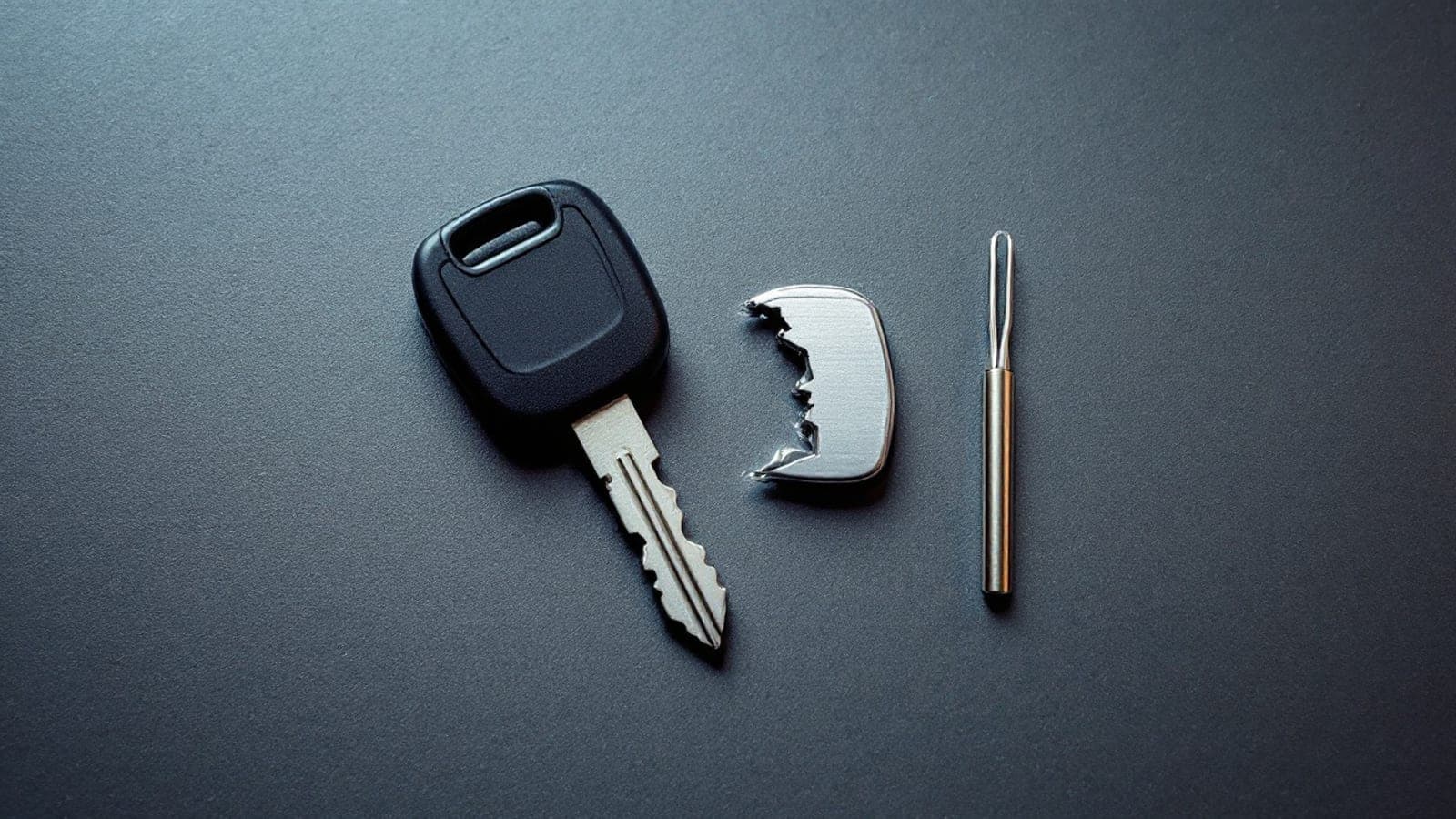
Broken Car Key Extraction Cost in Keller TX (2026)
Broken car key extraction in Keller TX costs $85 to $185, or about $200 to $400 with a new key. 2026 price table and the mistakes that double the bill.
Broken Car Key Extraction Cost in Keller TX (2026)
The head of the key is in your hand and the blade is still in the car. Before you reach for pliers, read the next two paragraphs, because the cheapest version of this job is the one where nobody has touched the lock yet. Call or text (817) 968-3866 and tell us where it broke and what position the ignition is in.
Quick Answer
Broken car key extraction in Keller TX costs $85 to $185 for the removal itself, whether the blade is in the ignition, a door or the trunk. Most people also need a working key afterwards, so a typical visit totals roughly $200 to $400 with a new chip key cut and programmed, plus a $45 to $95 mobile service call. A damaged ignition cylinder is the thing that pushes it higher.
Pricing below is as of October 2026 for Keller, Watauga, Southlake, Colleyville, Haslet and North Richland Hills.
What You Are Actually Paying For
People call this one job. It is three, and knowing which of the three you need is how you read a quote properly.
Job one is getting the fragment out. This is the extraction itself. It is a skilled, patient task done with thin spring-steel extractor tools that slide along the cuts of the blade and hook it from the side. It is priced on its own because sometimes it is the only thing you need.
Job two is giving you a key that works. A snapped key is not coming back. Even if both halves are sitting in your palm, a glued or soldered blade is a key that will break again, and the second time it tends to break deeper. So almost every extraction is followed by a new key, cut either from the two halves, by decoding the lock, or from the factory key code.
Job three is fixing the reason it broke. Keys do not snap in healthy locks. Either the key was worn thin and fatigued, or the cylinder was binding and you were forcing it, or both. If the cylinder is the problem and we only hand you a new key, you will be calling again in a few months with a new key broken in the same place.
A good quote tells you which of those three it covers. A bad one gives you a single low number for job one and lets you discover the other two in your driveway.
Broken Key Extraction Price Table
Every figure here comes from the same price bands we publish across this site, so the numbers match what you will be quoted on the phone.
| Service | Typical range |
|---|---|
| Diagnosis at your location, applied to the job if you proceed | $0 – $95 |
| Broken key extracted from the ignition cylinder | $85 – $185 |
| Broken key extracted from a door or trunk lock | $85 – $185 |
| Plain mechanical key, older vehicle, cut only | $15 – $40 |
| New key cut to factory code, replacing a worn or broken key | $95 – $300 |
| Transponder chip key, cut and programmed | $95 – $220 |
| Remote head key, cut and programmed | $140 – $300 |
| Flip key, cut and programmed | $150 – $320 |
| Emergency blade only, for a push-to-start fob | $85 – $165 |
| Transponder or immobilizer reprogram after ignition work | $80 – $180 |
| Ignition lock cylinder rebuild or rekey, where serviceable | $220 – $400 |
| Ignition lock cylinder replacement, keyed to your existing key | $280 – $520 |
| Cylinder replacement plus transponder programming | $320 – $560 |
| Mobile service call to your location | $45 – $95 |
| After-hours surcharge | ~$100, quoted up front |
The row most people land on is the extraction plus one of the key rows. The cylinder rows only come into play when the lock itself is damaged, and the single biggest cause of a damaged lock on these calls is a rescue attempt that happened before we were called.
What Changes the Price
Where the blade is sitting
A blade snapped in a door lock is the gentlest version. The door cylinder is exposed, it is not holding the steering column, and the car is not stuck in a half-on state. The same goes for a trunk lock.
A blade snapped in the ignition is more delicate, mostly because of what the ignition is doing at that moment. Which leads to the next point.
What position the ignition was in when it broke
This matters more than almost anything else and it is the first thing we will ask.
- Broke in the LOCK or OFF position. The cylinder is at rest, the wafers are sitting where the extractor tools expect them, and the fragment usually comes straight out.
- Broke in ACC or ON. The cylinder is rotated. The fragment has to be turned back to the removal position before it will slide out, with nothing to grip. This takes longer and sits toward the upper end of the extraction band. It also means your dash may be live and your battery is draining while you wait, so say so on the call.
- Broke while the engine was running. It happens. The car keeps running, and now you cannot shut it off the normal way. Do not panic and do not start prying. Call, and we will talk you through it.
How deep the fragment is
If a sliver of the blade is still proud of the cylinder face, extraction is quick. If it broke flush, it is routine. If it broke deep, because a second key or a tool was pushed in behind it, the job is slower and the risk to the wafers goes up.
Whether you still have the head of the key
Keep both pieces. The head matters for two reasons. First, on a chip key the transponder lives in the head, not in the blade, so the vehicle still recognizes that head. Second, the two halves together give us the full set of cuts to copy without decoding the lock.
If the head is lost, we can still make a key by decoding the cylinder or from the factory key code with proof of ownership. It adds a step, not a disaster.
What kind of key it was
This decides which key row you land on.
- A plain metal key on an older vehicle with no immobilizer is the cheapest: $15 to $40 for the new key after the extraction.
- A transponder chip key needs to be cut and then introduced to the vehicle: $95 to $220.
- A remote head or flip key has the buttons built into the head: $140 to $320 depending on style.
- An emergency blade from a push-to-start fob is its own case. If the little hidden blade snapped in a door lock, your fob still starts the car. You need the fragment removed and a new blade cut, $85 to $165, and nothing has to be programmed.
The condition of the cylinder
If the lock was already stiff, or if wafers were bent during a home extraction attempt, the cylinder may need a rebuild ($220 to $400) or replacement ($280 to $520, or $320 to $560 with transponder programming). We do not recommend that work unless the cylinder actually fails a test with the new key. A new, correctly cut key in a healthy cylinder turns like it is on bearings. If it does not, the cylinder is telling us something.
Whether anything is already in the keyway
Superglue on a matchstick, a snapped bobby pin, a second key jammed in behind the first, the tip of a pair of tweezers. Every one of these turns a clean extraction into a salvage job. We are not saying it to scold anyone, we are saying it because it is the most common reason this job leaves the $85 to $185 band.
Time of day and where you are
The mobile service call is $45 to $95 and is quoted before we head your way. Outside normal hours there is a surcharge of about $100, and you will hear that number on the phone, not on the invoice. If the car is safely parked at home and it is midnight, waiting until morning is a perfectly reasonable way to save it.
Four Real-World Totals
To make the table concrete, here is how the common versions of this call add up. These are ranges built from the table above, before the service call.
- Emergency blade snapped in the driver door, push-to-start vehicle. Extraction $85 to $185, new blade $85 to $165. Roughly $170 to $350, and no programming at all because the fob never stopped working.
- Chip key snapped in the ignition in the OFF position, both halves in hand. Extraction $85 to $185, new transponder key $95 to $220. Roughly $180 to $405. This is the most common call.
- Remote head key snapped in the ignition, head lost. Extraction $85 to $185, new remote head key $140 to $300, with the lock decoded to get the cuts. Roughly $225 to $485.
- Chip key snapped in a worn ignition that then fails with the new key. Extraction, new key, and a cylinder rebuild at $220 to $400. This is the one that runs past $500, and it is the one a spare key and an early phone call would have prevented.
Why Car Keys Snap in the First Place
A key rarely fails on the day it was abused. It fails on an ordinary Tuesday after years of small insults.
Metal fatigue at the shoulder. The blade is thinnest at its deepest cut, and on many keys the deepest cut sits close to the head. Every turn flexes that point slightly. After enough years it cracks, and one cold morning it lets go.
A heavy keyring. A fistful of keys, a bottle opener and a gym tag hanging off the ignition key act like a pendulum over every bump on Keller Parkway. That weight wears the cylinder and levers on the blade at the same time.
Using the key as a tool. Opening boxes, scraping ice, prying a battery cover. Each one puts a bend in the blade that you cannot see.
Forcing a binding lock. When the steering wheel is loaded against the column lock, the key will not turn. The fix is to take the weight off the wheel by rocking it gently while turning. The instinct is to turn harder. Blades lose that contest. We go through the full list of causes in why a worn car key stops turning.
A copy of a copy. A duplicate cut from a worn key carries the wear forward and adds its own error. By the third generation the key is fighting the wafers on every turn.
What Not to Do While You Wait
- Do not push anything in after the fragment. Not the broken head, not a second key, not a pick. All it does is drive the blade deeper and bend wafers.
- Do not use glue. The glue trick fails far more often than it works, and when it fails it bonds the fragment to the wafers. That turns an extraction into a cylinder replacement.
- Do not try to start the car with the broken head. Pressing the head against the fragment can turn the cylinder, but it can also shear what is left of the blade or leave you with a running car and no way to turn it off.
- Do not spray oil into the keyway. Oil collects grit and makes the fragment harder to grip. If any lubricant is needed, we use a dry one.
- Do leave the gear selector and steering wheel alone if the fragment is in the ignition. Changing the load on the column can trap it.
If the fragment is sitting proud and you can grip it firmly with needle-nose pliers and it slides straight out with no resistance, fine. That is the one home fix that works. The moment it resists, stop.
How the Extraction Is Done
It helps to know what you are paying for.
First we look, with a light and a scope, at how the fragment is sitting and what position the cylinder is in. Then a dry lubricant goes into the keyway. An extractor, which is a thin strip of spring steel with tiny barbs, slides in alongside the blade in the groove the cuts leave open. A second extractor often goes in on the other side. The fragment is then drawn out between them, a millimetre at a time, without rotating or levering the wafers.
If the cylinder is rotated to ACC or ON, the fragment is first turned back to the removal position using the extractors as a tension tool.
Once it is out, the two halves are laid together and the cuts are read. If the key was worn, we do not copy the worn cuts. We cut the new key to the original factory depths, which is why a new key often feels tighter and better than the old one ever did.
Last comes the test: the new key in the ignition, in every door, and in the trunk, through every position, several times. If it is a chip key, the programming is confirmed by starting the engine. We covered the mechanics in more detail in broken key extraction from the ignition.
Is the Chip in the Old Key Still Good?
Usually, yes. On a chip key the transponder is a small glass or carbon capsule moulded into the plastic head. The blade snapping does not hurt it.
That gives two options. On some keys the original chip can be moved into a new key shell with a fresh blade, which avoids programming entirely. On others it is cleaner to cut and program a brand new key and keep the old head in a drawer as evidence of what the car expects. Which route is cheaper depends on the key, and we will tell you both numbers. The difference between copying a chip and registering a new one is explained in transponder key cloning versus programming.
Locksmith, Dealer or Tow Truck?
A dealership parts counter can order a key by VIN, but the dealer does not come to your driveway to pull a fragment out of your ignition. In practice the dealer route means a tow to the service department, a wait for the key to arrive, and then the extraction and programming billed as shop labour.
A mobile automotive locksmith does all three jobs where the car sits, usually in one visit. For a broken key specifically, that difference is most of the saving: you are not paying to move a car that cannot be started. If you want the general comparison beyond this one job, we laid it out in auto locksmith versus dealership for car key replacement.
One honest exception: if the key broke in a vehicle that also has a known ignition recall or is under a warranty that covers the lock cylinder, ask the dealer first. We would rather you get it covered.
How to Not Pay for This Twice
The cheapest broken-key call is the one that never happens.
- Look at your key. If the cuts look rounded, the blade has a visible bend, or there is a hairline at the shoulder, it is on borrowed time. A new key cut to factory code is $95 to $300 and takes less than an hour.
- Have a spare. If the key that snapped was your only one, you are also one step from an all-keys-lost job. A second key added at the same visit is the cheapest key you will ever buy. See why to cut a second key before you lose the first.
- Lighten the keyring. The ignition key should carry the fob and little else.
- Do not ignore a sticky ignition. A key that needs a jiggle is a warning. The full pricing for that repair is in our ignition switch and lock cylinder repair cost guide.
Frequently Asked Questions
How much does it cost to get a broken key out of an ignition in Keller TX?
The extraction itself is $85 to $185. Most drivers also need a new key, so the usual total is about $200 to $400 with a chip key cut and programmed, plus a mobile service call of $45 to $95. It only goes higher when the ignition cylinder is damaged and needs a rebuild or replacement.
Is it cheaper if the key broke in the door instead of the ignition?
The extraction is priced in the same $85 to $185 band, but door jobs tend to sit at the lower end because the lock is easier to reach and is never stuck in a rotated position. If it was the emergency blade from a smart key fob, no programming is needed afterwards.
Can you make a new key from the two broken pieces?
Yes. The two halves give us the full set of cuts. If the old key was worn, we cut the new one to the original factory depths instead of copying the wear, so the new key often works better than the old one did.
Do I need a whole new ignition after a key breaks in it?
Usually not. If the fragment comes out cleanly and a correctly cut new key turns smoothly through every position, the cylinder is fine. A rebuild or replacement is only worth doing when the cylinder still binds with a new key or the wafers were damaged during a removal attempt.
Will my car still recognize the old chip?
In most cases, yes. The transponder is in the plastic head of the key, and a snapped blade does not harm it. Keep the head, because it either lets us reuse the chip or confirms exactly what the vehicle expects.
The key broke with the engine running. What should I do?
Leave the fragment alone, put the vehicle in park with the parking brake on, and call. Do not try to turn it off with pliers or the broken head. We can shut it down safely and remove the fragment without damaging the cylinder.
Should I try superglue on the broken piece?
No. It is the most expensive mistake on this job. When it fails, the glue bonds the fragment to the wafers inside the lock, and a job that would have been an extraction becomes a cylinder replacement.
How long does broken key extraction take?
A clean extraction is often done in 15 to 30 minutes. Cutting and programming the new key adds roughly 20 to 45 minutes depending on the vehicle. A fragment that is deep, glued or sitting in a rotated cylinder takes longer.
Get the Fragment Out Before It Gets Expensive
Tell us three things and we can quote it accurately on the first call: where the key broke, what position the ignition is in, and whether you still have the head. Call or text (817) 968-3866. We come to you across Keller, Southlake, Colleyville, Watauga, Haslet, Argyle, Justin and North Richland Hills, and the price you hear on the phone is the price on the invoice.
Written by the Keller Locksmith automotive team, who pull broken keys out of ignitions and door locks across Tarrant and Denton County every week.
Need a locksmith now?
Licensed mobile automotive locksmith serving the area. 30-90 minute response.
Call (817) 968-3866