Rekey Locks After Moving In Keller TX: Cost, Process & When
Should you rekey or replace locks after buying a home in Keller TX? A locksmith's guide to cost, the rekey vs replace decision, ANSI grades, and timing.
TL;DR
If you just closed on a house in Keller, rekeying the exterior locks is the single cheapest security upgrade you will ever make — and most homeowners skip it. The reason it matters is simple: you have no idea how many working keys to your new front door are floating around. The seller, their kids, a former housekeeper, a dog walker, two real-estate agents, and the previous owner's parents may all still hold a key that turns your deadbolt today. The U.S. Census Bureau's Current Population Survey reports that roughly 25.6 million Americans moved in 2022, and the overwhelming majority of those resale homes changed hands with the existing locks — and existing keys — untouched.
Rekeying re-pins the lock cylinder so every old key stops working and one new key takes over. In the Keller and north Tarrant market, a mobile locksmith rekey runs roughly $19–$30 per cylinder in labor plus a service-call fee, so a typical 3–4 door house lands in the $120–$220 range for the visit. That is a fraction of what full lock replacement costs, and it takes a technician 10–15 minutes per lock. This guide covers when to rekey versus replace, what it actually costs in Keller, the ANSI security grades worth knowing, and how to verify a locksmith before you hand them access to your home. Our residential lock rekey service covers Keller, Southlake, Westlake, Colleyville, and north Fort Worth.
Why rekeying after a move is non-negotiable
When you buy a resale home, the keys you receive at closing are not a complete set — they are a set. There is no registry that tracks who else has a copy. Real-estate transactions routinely involve a lockbox, multiple showings, contractors during the inspection period, and the seller's own informal key-lending history going back years.
This is not paranoia; it is base-rate burglary risk. The FBI Uniform Crime Reporting program has long documented that a large share of residential burglaries involve unlawful entry without forced entry — the intruder walked in through an unlocked or keyed door. The Bureau of Justice Statistics reinforces this in its household burglary research: a meaningful percentage of completed burglaries show no sign of forced entry at all. A door that opens with a key the previous owner forgot they handed out is exactly that scenario.
There is also a financial angle most new homeowners miss. Many homeowner's insurance policies and home-security discounts assume you control access to your home. Per the Insurance Information Institute, burglary and theft losses are a standard component of homeowner's claims, and demonstrating reasonable security measures — controlled keys, graded deadbolts — is part of being a low-risk policyholder. Rekeying the day you take possession is the cleanest way to reset the access ledger to zero.
Rekey vs. replace: the decision that saves you money
The most common mistake new Keller homeowners make is buying brand-new locks at a big-box store when a rekey would have solved the problem for a third of the cost. Here is the honest framework.
When rekeying is the right call
Rekeying makes sense — and is what we recommend in the majority of move-in situations — when:
- The existing locks are structurally sound and operate smoothly.
- The locks are a reputable grade (a solid deadbolt, not a $9 entry-knob lock).
- You simply need old keys to stop working and a single new key to take over.
- You want all your exterior doors keyed alike so one key runs the whole house.
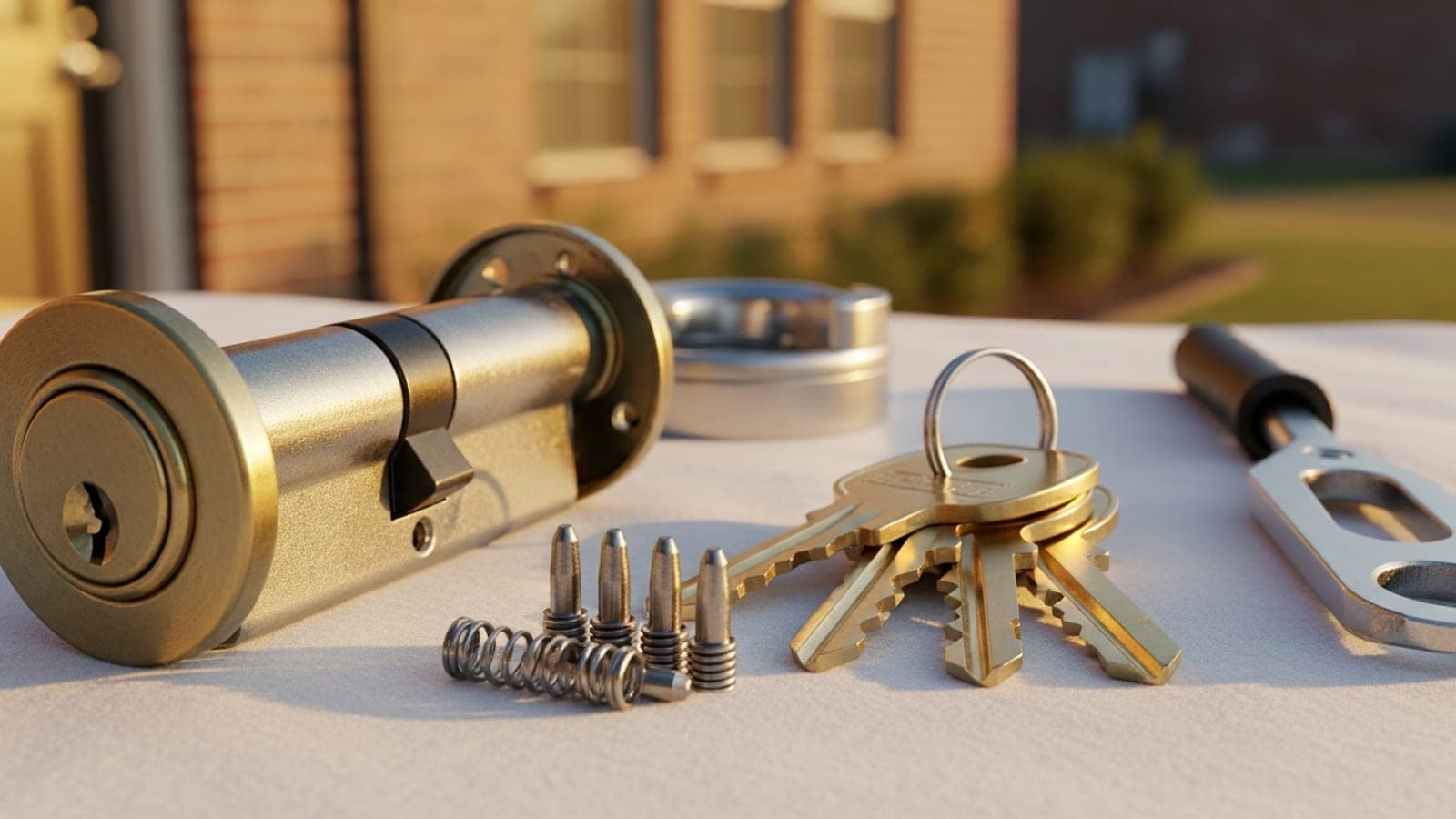
Rekeying keeps your existing hardware, finish, and door prep. The technician removes the cylinder, swaps the internal pin stack to a new combination, and cuts you a fresh key. The old keys are now dead metal.
When replacement is the right call
Replace the lock entirely when:
- The hardware is worn, corroded, or sticky and a rekey would just re-pin a failing lock.
- The deadbolt is a builder-grade or sub-Grade-3 lock you want to upgrade for security.
- You want to switch to a smart lock or keypad deadbolt (covered in our smart lock installation guide).
- The bore or backset is non-standard and the old lock is failing.
The deciding variable is usually the quality of what is already on the door. If the seller installed decent hardware, rekey it. If the door wears a flimsy lock, replacing it with a graded deadbolt is the smarter spend.
A cost comparison for a typical Keller home
| Approach | Per-door cost | 4-door house | What you get |
|---|---|---|---|
| Mobile rekey (keep hardware) | ~$19–$30 labor + trip fee | ~$120–$220 | All old keys dead, one new key, keyed-alike option |
| DIY rekey kit (single brand) | ~$12–$25 kit | ~$50–$100 + your time | Works only if all locks are the same brand; easy to mis-pin |
| New graded deadbolt (installed) | ~$60–$160 each | ~$300–$650+ | New hardware + security-grade upgrade |
| Smart/keypad deadbolt (installed) | ~$140–$320 each | ~$600–$1,200+ | Keyless entry, codes, app control |
Pricing reflects the Keller / north Tarrant mobile-locksmith market and varies by hardware brand, lock condition, and number of cylinders. For a written, flat-rate quote on your specific doors, see our rekey service page or call before the visit.
Understanding lock grades: ANSI/BHMA explained
If you are going to spend money on locks once, spend it understanding the grading system so you do not overpay for marketing or underbuy for security.
Residential and commercial locks in the U.S. are graded by the Builders Hardware Manufacturers Association (BHMA) under the ANSI/BHMA A156 standard. The grading runs from Grade 1 (highest) to Grade 3 (lowest), measured by cycle testing, strength, and finish durability:
- Grade 1 — Commercial-strength. Withstands the most operating cycles and forced-entry stress. Overkill for some homes, ideal for a primary entry you want bulletproof.
- Grade 2 — Strong residential / light commercial. The sweet spot for most Keller homes' front and back doors.
- Grade 3 — Basic residential minimum. Acceptable for interior or low-risk doors; under-protective for a main entry.
When the Associated Locksmiths of America (ALOA) discusses residential security, the recurring theme is that the deadbolt — not the knob — is the lock that resists entry, and that a graded deadbolt paired with a reinforced strike plate dramatically raises the bar for forced entry. A rekey preserves whatever grade you already own; if your inspection turned up bargain-bin locks, a move-in is the natural moment to step up to Grade 2 on exterior doors.
What the rekey process actually looks like
Homeowners often imagine rekeying as a mysterious procedure. It is not. Here is the full sequence for a mobile rekey in Keller:
- Walk-through and count. The technician counts cylinders — front door, back door, garage entry door, side gate, any keyed patio doors — and confirms which should be keyed alike.
- Cylinder removal. Each lock cylinder is removed from the door. On most residential deadbolts and knobs this takes a couple of minutes per lock.
- Re-pinning. The technician disassembles the cylinder, removes the existing pin stack, and installs new pins matched to a brand-new key combination. This is the step that kills every old key.
- Key cutting and testing. New keys are cut, the cylinder is reassembled and reinstalled, and the technician tests the lock multiple times to confirm smooth operation.
- Keyed-alike unification (optional). If you asked for it, every exterior lock is pinned to the same new combination so one key runs the house. This is the most-requested option from new homeowners and it costs nothing extra in pins — it just requires the locks be compatible.
- Handover. You receive your new keys and the old keys are now non-functional. Ask for a written invoice listing each lock serviced.
A typical 3–4 door Keller home is done in under an hour start to finish. There is no door damage, no drilling, and no need to repaint or re-prep anything.
A real-world example
Homeowner: A family that closed on a 4-bedroom resale home in the Hidden Lakes area of Keller, anonymized. They moved in over a weekend and called for a rekey the following Monday.
Before: Two house keys received at closing. The listing had been shown 14 times over six weeks, the home had a smart-lockbox during the inspection period, and the seller mentioned offhand that "the neighbor has a spare." Front door, back patio, and garage-entry door all keyed differently, requiring three separate keys.
Implementation: A mobile technician rekeyed all three exterior cylinders plus a keyed gate lock — four cylinders total — and unified them to a single new combination (keyed alike). Total on-site time was about 50 minutes.
Results (same day):
- Every previously circulating key — seller's, neighbor's, agents', lockbox era — rendered useless.
- The family went from three mismatched keys to one key for the whole house.
- Out-the-door cost landed in the low-$200s for four cylinders, well under a single new smart-lock purchase.
- No door damage, no repainting, hardware finish untouched.
Net: For roughly the cost of a nice dinner out, the homeowners reset their entire access perimeter on day three of ownership. Per the FBI UCR burglary data showing how often entry happens without force, eliminating unknown working keys is the highest-leverage, lowest-cost move a new homeowner can make.
What experts say
"The first 48 hours in a new home are the window people regret missing. Once you've unpacked and life resumes, the unknown keys stay out there for years. Rekeying is fifteen minutes a lock, and it converts an uncontrolled access list into one you actually own." — ALOA-affiliated residential locksmith, 16 years in the DFW market (anonymized)
Per the Bureau of Justice Statistics household burglary research, a substantial share of completed residential burglaries occur without forced entry — meaning the entry point was unlocked or accessed with a working key. The practical implication for a Keller homeowner is direct: controlling who holds a working key is not a minor convenience issue, it is a primary security control, and a move-in is the cleanest moment to enforce it.
Keller, Southlake & north Tarrant: local context
Keller sits in a high-turnover stretch of north Tarrant County, with neighboring Southlake, Westlake, Colleyville, and Trophy Club seeing steady resale activity. The U.S. Census Bureau tracks Keller's housing stock as predominantly owner-occupied single-family homes — the exact profile where resale-with-existing-locks is the norm. Each of those transactions is a household that should rekey and mostly does not.
Because the market here skews toward larger homes, the per-house cylinder count tends to run higher than a starter home — front, back, garage-entry, and sometimes a side or pool-gate lock. That makes the keyed-alike option especially valuable locally: nobody wants to juggle four different keys for a four-door house. A mobile locksmith serving the Keller area can rekey and unify all of them in a single visit, which is why we built our lock rekey service around same-day mobile dispatch across the north Tarrant corridor. For higher-security needs, our high-security lock service covers Grade-1 deadbolt upgrades.
How to verify a locksmith before you hand over access
You are about to give a stranger physical access to your home's locks. Vet them. The Federal Trade Commission has published consumer guidance warning about locksmith bait-and-switch scams — a lowball phone quote that balloons on arrival, often from out-of-area call centers. Run this checklist before you book:
- Get a written or texted quote with the per-cylinder rekey rate and the trip fee stated up front.
- Confirm they're local — a real Keller-area mobile locksmith, not a national call center routing to whoever's cheapest.
- Ask whether they're insured and bonded for residential work.
- Verify the business name matches the vehicle, the invoice, and the phone greeting.
- Decline "drill the lock" upsells on a standard residential deadbolt — rekeying never requires drilling a functioning lock.
- Read recent local reviews rather than trusting a generic 5-star claim. Per BrightLocal's Local Consumer Review Survey, the overwhelming majority of consumers read online reviews before choosing a local service business — use that habit here.
- Insist on an itemized invoice listing each lock serviced.
A legitimate locksmith welcomes every one of these. Resistance to any of them is the signal to hang up.
Frequently asked questions
Q: How much does it cost to rekey locks after moving in Keller TX? A: In the Keller and north Tarrant market, mobile rekeying runs roughly $19–$30 per cylinder in labor plus a service-call fee, so a typical 3–4 door home lands around $120–$220 for the visit. The exact figure depends on the number of cylinders, the lock brand, and whether you want everything keyed alike. Always get the per-cylinder rate and trip fee in writing before booking — see our rekey service page for a flat-rate quote.
Q: Should I rekey or replace the locks on a house I just bought? A: Rekey if the existing locks are sound and a decent grade — it's a third of the cost and keeps your hardware. Replace if the locks are worn, sticky, or sub-grade, or if you want to upgrade to a graded deadbolt or a smart lock. The deciding factor is the condition and quality of what's already on the door.
Q: Can I just rekey the locks myself with a kit? A: You can if every exterior lock is the same brand and you buy the matching DIY kit. The catch is that move-in homes frequently have mixed-brand hardware, and mis-pinning a cylinder is easy for a first-timer, which can leave a lock that binds or fails. A mobile locksmith handles mixed brands, unifies everything to one key, and tests each lock — usually for a modest labor charge over the DIY parts cost.
Q: How long does rekeying a whole house take? A: About 10–15 minutes per cylinder, so a typical 3–4 door Keller home is done in under an hour. There's no drilling, no door damage, and no need to repaint or re-prep the door.
Q: Will rekeying let me use one key for every door? A: Yes — it's called keying alike, and it's the most-requested option from new homeowners. As long as the locks are compatible, the technician pins every exterior cylinder to the same new combination so a single key runs the whole house, at no extra parts cost.
Q: Is rekeying really necessary, or am I being oversold? A: It's genuinely necessary after a resale purchase because you cannot account for every working key the prior owner ever handed out. Per FBI and Bureau of Justice Statistics data, a large share of residential burglaries occur without forced entry — meaning a working key or unlocked door was the entry point. Rekeying resets that risk to zero for the lowest cost of any security measure.
The bottom line
Rekeying after a move is the rare security upgrade that is both cheap and genuinely high-impact. For roughly $120–$220, you take an access list you didn't write — full of keys you can't account for — and replace it with one key you control. The job is fast, non-destructive, and leaves your existing hardware intact. The only real decision is rekey versus replace, and that comes down to the quality of the locks already on your doors. If they're sound, rekey. If they're tired or sub-grade, upgrade. Either way, do it in the first week, before the boxes are unpacked and the unknown keys fade from mind.
Next steps
If you've just moved into a home in Keller, Southlake, Westlake, Colleyville, or north Fort Worth, our residential lock rekey service covers same-day mobile dispatch with flat-rate, written quotes — no surprise upsells. For a security-grade upgrade, see our high-security lock service, and if you're considering going keyless, read the smart lock installation guide. Questions before you book? Contact us or call (817) 968-3866.
Need a locksmith now?
Licensed mobile automotive locksmith serving the area. 30-90 minute response.
Call (817) 968-3866